Screen Reader Access
CSIR-IIIM, 23rd December 2025
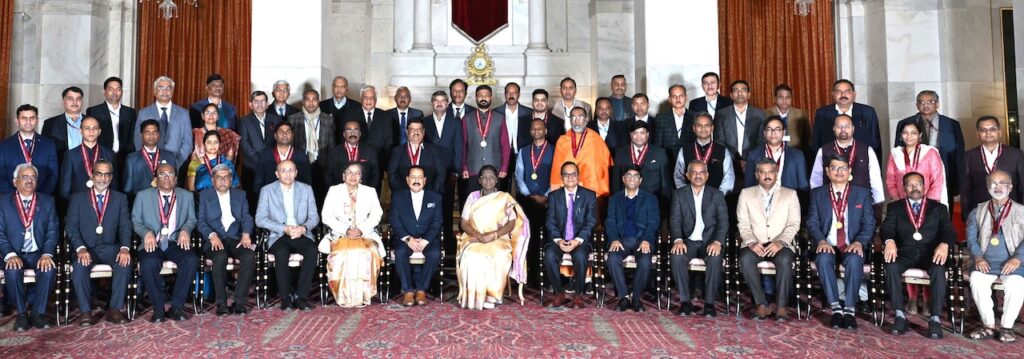
At the second “Rashtriya Vigyan Puraskar” ceremony held at Rashtrapati Bhavan today, the prestigious “Rashtriya Vigyan Ratna Puraskar 2025” for lifetime achievement was awarded posthumously to eminent astrophysicist Prof. Jayant Vishnu Narlikar while the entrepreneurial science team that powered India’s much-discussed “Purple Revolution” and Lavender entrepreneurship found national recognition in ”Rashtriya Vigyan Team Puraskar 2025″ or Vigyan Team Award , which was bagged by the CSIR-led Aroma Mission. President of India, Droupadi Murmu presented the awards to 24 scientists and innovators across disciplines, in the presence of Union Minister of Science and Technology Dr. Jitendra Singh. The Rashtriya Vigyan Puruskars were instituted by the Modi government. Taking to ‘X’ , Dr Jitendra Singh wrote, “Congratulations “Team Aroma” for the coveted #RashtriyaVigyanPuruskar 2025, in recognition of your contribution in gifting the world the concept of “Purple Revolution” and presenting “Lavender” as a new avenue of Agri-Entrepreneurship….kindling prospects of attractive livelihood even in remote hilly terrains of the Himalayas”.
The Aroma Mission team, working under the Council of Scientific and Industrial Research, has been widely credited with translating laboratory research into field-level outcomes by promoting cultivation and processing of aromatic crops, particularly lavender, in the Himalayan region. Its work helped open up new livelihood avenues for farmers in Jammu and Kashmir, reduced dependence on imports of essential oils, and demonstrated how coordinated scientific intervention can lead to measurable socio-economic impact. The recognition places collaborative, application-oriented science at the centre of the national awards framework. The Lavender cultivation and entrepreneurship, beginning from Bhaderwah and Gulmarg townships of J&K has now spread in other parts of the UT also and is being adopted by other States like Uttarakhand and Himachal Pradesh as well.
The Rashtriya Vigyan Puraskar, instituted last year as part of a new national science awards architecture, is designed to acknowledge scientific work across the full spectrum — from lifetime achievement to early-career excellence and team-based innovation. This year’s ceremony marked the second edition of the awards, underscoring the government’s intent to present science and technology honours in a structured, contemporary format aligned with global best practices. Among the honours announced, the Vigyan Ratna for lifetime achievement was awarded posthumously to eminent astrophysicist Prof. Jayant Vishnu Narlikar, while several Vigyan Shri and Vigyan Yuva awards recognised individual contributions across physics, agriculture, biological sciences, chemistry, engineering, medicine, space science, mathematics, and technology. The full list of awardees spans senior scientists as well as researchers below the age of 45, reflecting the award’s emphasis on both experience and emerging talent.
Under the Vigyan Shri category, which recognises distinguished contributions in specific fields, awards were conferred on Dr. Gyanendra Pratap Singh (Agricultural Science), Dr. Yusuf Mohammad Sheikh (Atomic Energy), Dr. K. Thangaraj (Biological Sciences), Prof. Pradeep Thalappil (Chemistry), Prof. Aniruddha Bhalchandra Pandit (Engineering Sciences), Dr. S. Venkata Mohan (Environmental Science), Prof. Mahan Mj (Mathematics and Computer Science), and Shri Jayan N (Space Science and Technology), highlighting sustained and field-defining work across disciplines. The Vigyan Yuva–Shanti Swarup Bhatnagar Award, aimed at scientists below the age of 45, recognised emerging researchers for innovative contributions. Awardees included Prof. Amit Kumar Agarwal and Prof. Surhud Shrikant More in Physics; Dr. Jagdis Gupta Kapuganti and Dr. Satendra Kumar Mangrauthia in Agricultural Science; Dr. Deepa Agashe and Shri Debarka Sengupta in Biological Sciences; Dr. Dibyendu Das in Chemistry; Dr. Waliur Rahaman in Earth Science; Prof. Arkaprava Basu in Engineering Sciences; Prof. Sabyasachi Mukherjee and Prof. Shweta Prem Agrawal in Mathematics and Computer Science; Dr. Suresh Kumar in Medicine; Shri Ankur Garg in Space Science and Technology; and Prof. Mohanasankar Sivaprakasam in Technology and Innovation. Women scientists featured prominently among this year’s awardees, with recognition across multiple categories and disciplines. Researchers such as Dr. Deepa Agashe and Prof. Shweta Prem Agrawal were honoured for their work, reflecting the growing participation and leadership of women in India’s scientific ecosystem.
The CSIR Aroma Mission Team comprising Dr Zabeer Ahmed (Director, CSIR – Indian Institute of Integrative Medicine, Jammu), Dr Prabodh K Trivedi, Dr Anil Kumar Tripathi, Dr Alok Kalra, Dr Ram Vishwakarma, Dr D S Reddy, Dr Sudesh Yadav and Dr Ajit Kumar Shasany, received the Vigyan Team Award in the Agricultural Science category for its sustained efforts in integrating research, technology and field-level implementation to strengthen rural livelihoods and promote sustainable agriculture. CSIR Aroma Mission has emerged as a key driver in enhancing domestic production of essential oils, reducing import dependence and creating new income opportunities for farmers across several states. Through the Mission, more than 75 lakh aromatic plants have been cultivated, resulting in a 20 to 30 per cent increase in farmer incomes.
From Phase I to Phase III, the Mission has expanded the area under aromatic crops by an additional 51,000 hectares, leading to an increase of around 6,000 tonnes in domestic essential oil production. This expansion has generated an estimated economic value of Rs 660 crore, contributing significantly to import substitution and strengthening export potential. The Mission has also focused on developing advanced agro-technologies and improved crop varieties. A total of 52 agro-technologies have been developed and 80 improved varieties released, enabling farmers to generate additional income of over Rs 50,000 per hectare.