Screen Reader Access
CSIR-IIIM, 24th February 2026
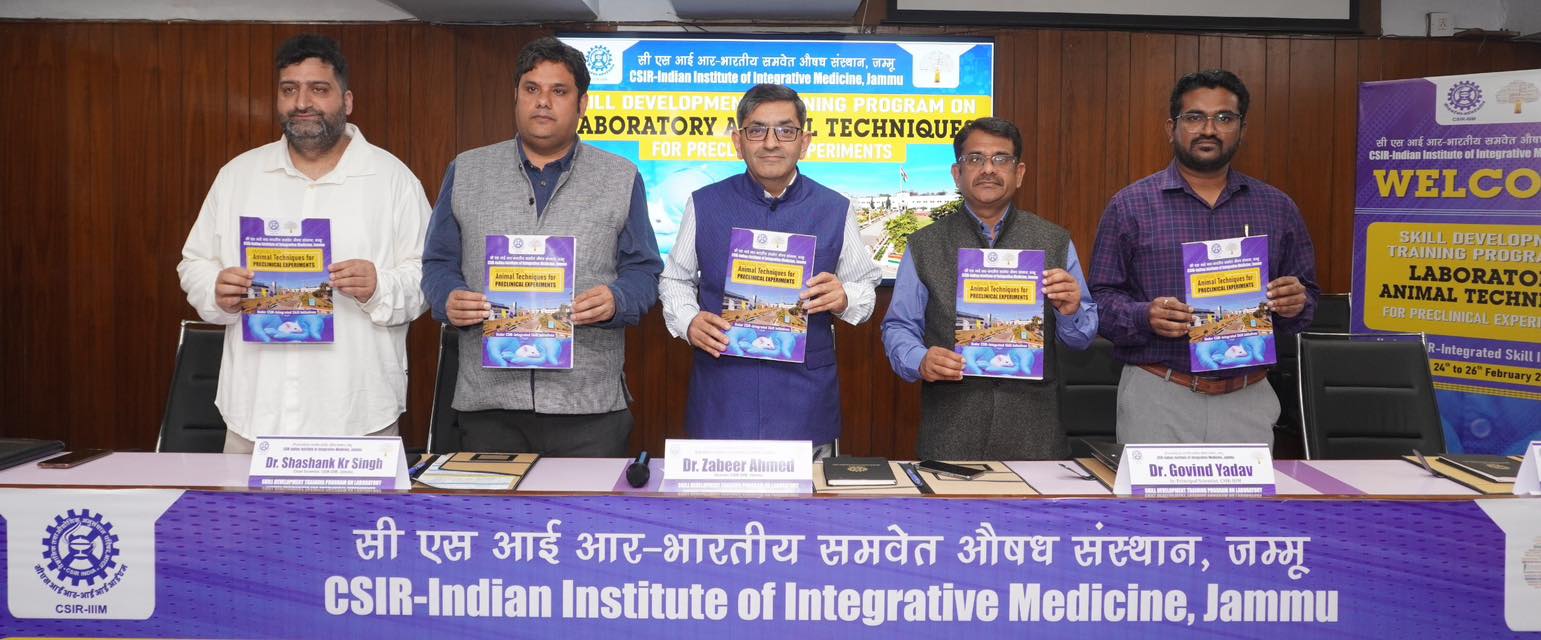
The CSIR-Indian Institute of Integrative Medicine (CSIR-IIIM), Jammu, inaugurated a three-day skill development training programme on “Laboratory Animal Techniques for Preclinical Experiments” at its Canal Road campus. The programme aims to provide hands-on technical exposure and strengthen foundational skills required for preclinical research in Biomedical and Life Sciences. The training has drawn participants from diverse academic and professional backgrounds including Biological Sciences, Pharmaceutical Sciences, Veterinary Sciences, and allied disciplines.
Addressing the inaugural session, Dr Zabeer Ahmed, Director of CSIR-IIIM Jammu, highlighted the institute’s rich scientific legacy and its pivotal role in drug discovery and integrative medicine. He underlined that preclinical research forms the backbone of drug development, encompassing efficacy studies, toxicology analyses, and safety pharmacology before a molecule advances to clinical trials. He stressed that laboratory animal experimentation must strictly adhere to ethical frameworks and Good Laboratory Practices (GLP), aligning with global regulatory guidelines to ensure internationally acceptable data. He noted that CSIR-IIIM possesses comprehensive facilities – ranging from natural product exploration and agrotechnology to chemical extraction, molecular modification, biological evaluation, and GLP-compliant animal experimentation.
The programme is structured to combine theoretical orientation with practical demonstrations and hands-on sessions. Participants will receive training in laboratory animal handling and restraining techniques, dosing procedures, biological sample collection, and stress-minimising practices. Modules also include DNA, RNA and protein isolation techniques, histopathological procedures, and ethical and biosafety considerations governing animal experiments.
Day-1 began with the technical sessions covered an overview of the training programme, biology of laboratory animals, and laws and ethics governing animal experiments. Participants also received hands-on training in handling and restraining of laboratory animals, an essential skill for conducting safe and ethical preclinical studies.
Earlier, Dr Shashank Kr Singh, Chief Scientist, delivered the welcome address, emphasising the critical role of experimental planning, biomarker evaluation, and proper handling strategies in generating reliable scientific outcomes. Dr Ramajayan Pandian, Senior Scientist, provided an overview of the training programme, explaining that the course covers experimental design, selection of appropriate animal models, stress and pain reduction strategies, and accuracy in data collection. Dr Govind Yadav, Senior Principal Scientist, spoke on the importance of generating quality and regulatory-compliant data acceptable not only in India but also in international markets such as the US and Europe. Principal Scientist Dr Nasir ul Rasheed presented vote of thanks.